
India Needs Climate OKRs —
Not Just Climate Plans
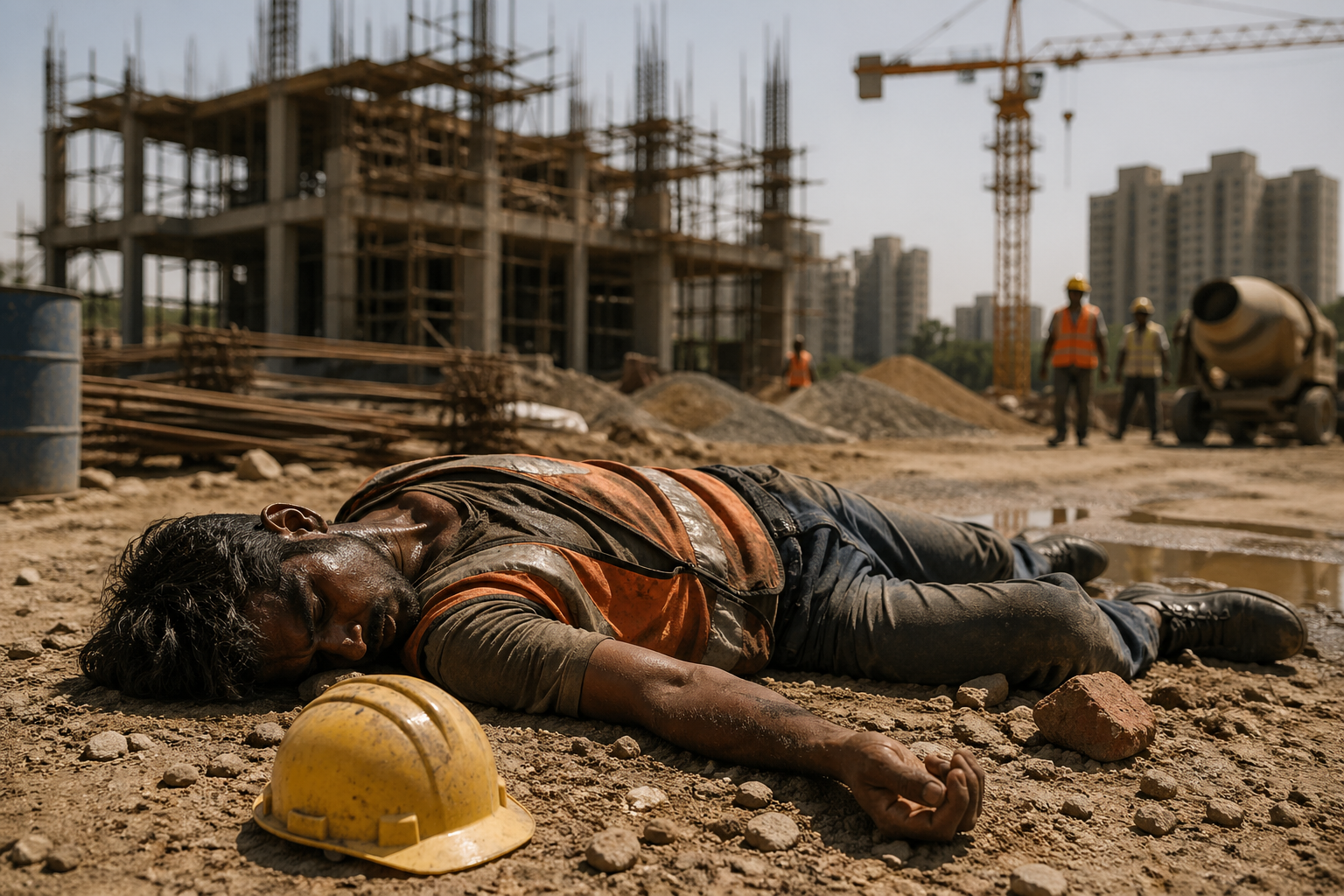
Last week, a construction worker collapsed in Jalgaon, Maharashtra. He wasn’t sick. He didn’t have a pre-existing condition. He died because it was simply too hot for the human body to survive. No headlines. No outrage. Just another casualty in a crisis that barely registers anymore.
This is the story of a country that is heating up faster than its systems can respond — and a conversation we urgently need to have about why good intentions and ambitious plans are no longer enough.
This Is Not Your Childhood Summer
Many of us grew up hearing: “India is a hot country. This is just summer.” That explanation no longer holds. What we are witnessing today is categorically different from the heat of previous decades.
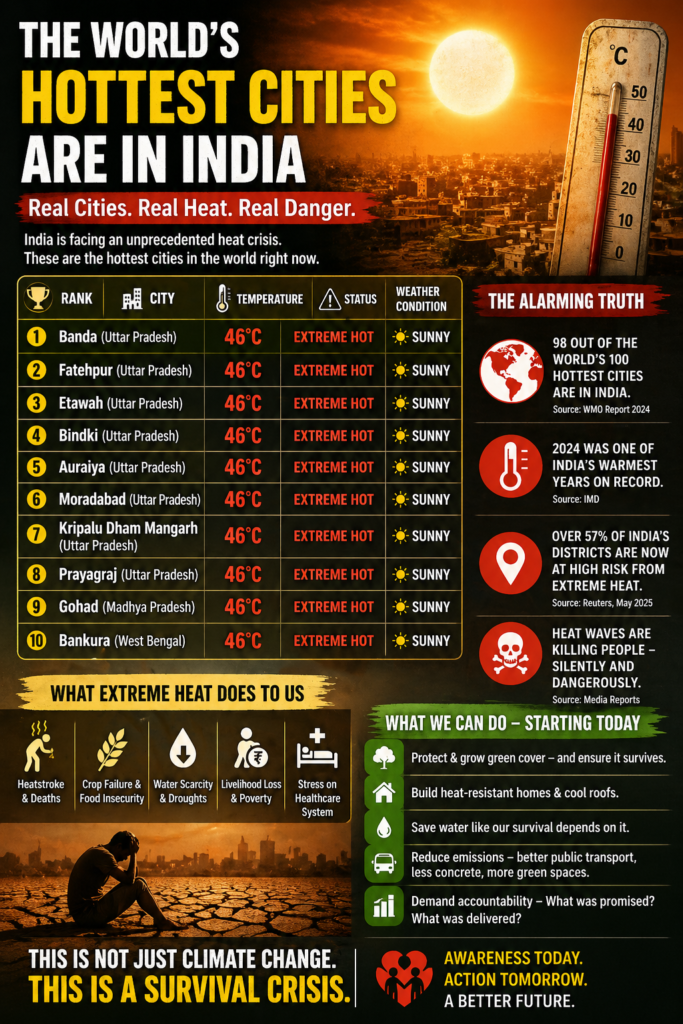
The most alarming shift isn’t daytime temperatures — it’s what happens after dark. Night-time temperatures across India have been rising steadily, and 2025 was marked as one of the most extreme years on record for this phenomenon. The human body needs cool nights to recover from heat stress. When that recovery window disappears, the danger multiplies.
“When even the night stops offering relief, the body has no time to recover. Prolonged heat stress becomes a slow, invisible emergency.”
Heatwaves are no longer just uncomfortable — they are becoming physiologically unsurvivable in some regions. Climate scientists have begun using the term “wet-bulb temperature” — the threshold beyond which sweating can no longer cool the body. Parts of India are approaching this threshold with increasing frequency.
The Chain Reaction Nobody Is Talking About
Heat is the headline, but climate change arrives as a cascade. Every extreme event triggers the next. India experienced extreme weather on nearly every single day through the first nine months of 2025 — a statistic that would have seemed unthinkable a generation ago.
- Heatwaves shrink the window for outdoor labour, cutting productivity and income for millions of daily-wage workers
- Even a 1°C rise in growing-season temperature can reduce wheat and rice yields by 3–7%, threatening food security
- Floods in one state and drought in an adjacent state simultaneously have become the new normal
- Groundwater reserves — already critically depleted — are further stressed as demand spikes during heat emergencies
- Heat-related deaths are rising but are systematically undercounted because hospitals rarely record “heat” as cause of death
UN agencies issued a stark warning in April 2026: extreme heat is now directly threatening global food systems. For India — home to 1.4 billion people and one of the world’s most agriculture-dependent economies — the stakes could not be higher. Rising food prices, water scarcity, and mass migration from heat-stressed rural regions are not distant possibilities. They are already beginning.
So Why Aren’t We Acting Fast Enough?
India has signed the Paris Agreement. It has announced ambitious renewable energy targets. State governments publish Heat Action Plans. The National Action Plan on Climate Change has existed since 2008. On paper, the country looks engaged.
So why are construction workers still dying?
The answer lies in the gap between planning and accountability. We are exceptionally good at producing documents. We are far less good at tracking whether those documents change anything on the ground.
Plans without measurement are just intentions with good formatting.
India doesn’t lack climate ambition. It lacks a system that makes accountability impossible to avoid.
Consider how India’s most successful transformations have worked: UPI revolutionised payments not through a plan but through a measurable target — transactions per day, onboarding rates, fraud reduction. Aadhaar’s rollout was tracked obsessively against enrolment numbers. When a goal has a number attached to it and someone is publicly responsible for that number, progress happens at a different pace.
Climate action has not yet received that same rigour.
What Would Climate OKRs Actually Look Like?
OKRs — Objectives and Key Results — are a goal-setting framework that emerged from Silicon Valley and have been adopted by some of the world’s most effective organisations. The principle is simple: define a clear, ambitious objective, then tie it to a small number of specific, measurable outcomes that tell you whether you’re making progress.
Applied to cities and states, this framework could transform how India addresses climate change. Here’s a concrete illustration:
| Objective / Key Result | What it means on the ground | Who owns it |
|---|---|---|
|
Objective Make Mumbai heatwave-resilient by 2027 |
Zero preventable heat deaths; all residents with access to cooling | Municipal Corporation of Greater Mumbai |
|
Key Result 1 Open 500 cooling centres by May 2026 |
Every ward has at least two publicly accessible, air-conditioned spaces during heat alerts | Ward Officers + Disaster Management Dept |
|
Key Result 2 Register 2 lakh outdoor workers in heat-alert SMS system |
Construction workers, vendors, delivery riders receive advance warning and protocol guidance | Labour Department |
|
Key Result 3 Plant 1 lakh trees in urban heat islands by Dec 2026 |
Measurable canopy cover increase in the five hottest neighbourhoods | BMC Environment Cell |
|
Key Result 4 Reduce heat-related hospital admissions by 30% |
Tracked against 2024 baseline; reported publicly every quarter | State Health Department |
Notice the difference. This isn’t a policy document. It’s a contract — with specific owners, specific numbers, and a specific deadline. The moment you make a goal measurable and assign a name to it, the conversation changes from “we are working on it” to “here is our current number and here is why it is or isn’t on track.”
Traditional climate plans are often aspirational and long-horizon — “net zero by 2070” is real, but it doesn’t tell a ward officer what to do on Monday morning. OKRs break the large goal into quarterly, ownable pieces. They make progress visible, failure hard to hide, and success genuinely celebratable. That combination changes behaviour at every level of an organisation — or a government.
This Cannot Be Only the Government’s Job
Climate accountability cannot live inside one ministry. The physics of the problem — distributed emissions, diffuse impacts — mirrors the solution. Every actor in the system needs a role, and crucially, every actor needs to see their role as genuinely consequential.
Government
Set binding city-level OKRs. Publish progress dashboards publicly. Tie infrastructure budgets to climate performance metrics.
Businesses
Adopt scope 3 emission tracking. Build supplier accountability into procurement. Report climate risk in annual disclosures.
Communities
Form neighbourhood watch groups for heat emergencies. Advocate for tree cover. Hold elected representatives to published targets.
Citizens
Reduce personal carbon footprint consciously. Vote for accountability. Demand public dashboards from your city government.
The critical word in that last point is demand. Citizens who treat climate OKRs as something to follow passively are missing the point. The power of the framework comes from public visibility — when every resident of Chennai can see whether their corporation is on track to plant 50,000 trees this monsoon, accountability becomes structural rather than voluntary.
From Awareness to Architecture
India is not short on people who understand the climate crisis. It is not short on empathy, creativity, or even ambition. What the country is short on is a system that translates all three into consistent, accountable action — and that refuses to let things slip quietly when progress stalls.
Every major transformation India has achieved in recent decades — economic, digital, logistical — happened when a measurable goal was combined with a named owner and a public scorecard. The Green Revolution. Polio eradication. UPI adoption. None of these succeeded because the right people had the right intentions. They succeeded because the right people had the right incentive structure.
Climate action needs that same architecture. Not more plans. Not more summits. A system that makes inaction visible and accountability automatic.
“We don’t need to convince more people that the crisis is real. We need to build systems that make acting on it impossible to avoid.”